
South Africa’s Conduct of Financial Institutions Bill (COFI) is set to raise the bar on conduct by focusing on customer outcomes. COFI is expected to be enacted during 2026, and the Financial Sector Conduct Authority has listed preparation as a priority. The challenge is not reading the law. It is showing, with evidence, that customers receive fair treatment.
Key takeaways
- COFI increases scrutiny on customer outcomes, not just policies.
- Boards need clearer conduct reporting and faster escalation.
- Complaints and redress will draw attention under the National Financial Ombud Scheme.
- Data quality and document retention become conduct controls.
What COFI is and why 2026 matters
National Treasury describes COFI as an entity-facing conduct framework that sets requirements for financial institutions under the FSCA and the outcomes those institutions are expected to deliver.
It also leans toward an activity-based model, which points to more consistent conduct expectations across banking, insurance, investments, and advice.
For the public, the “COFI era” will show up in product explanations, pricing, cancellations, claims, advice quality, and how quickly a firm corrects repeated issues.
What leaders should focus on in 2026
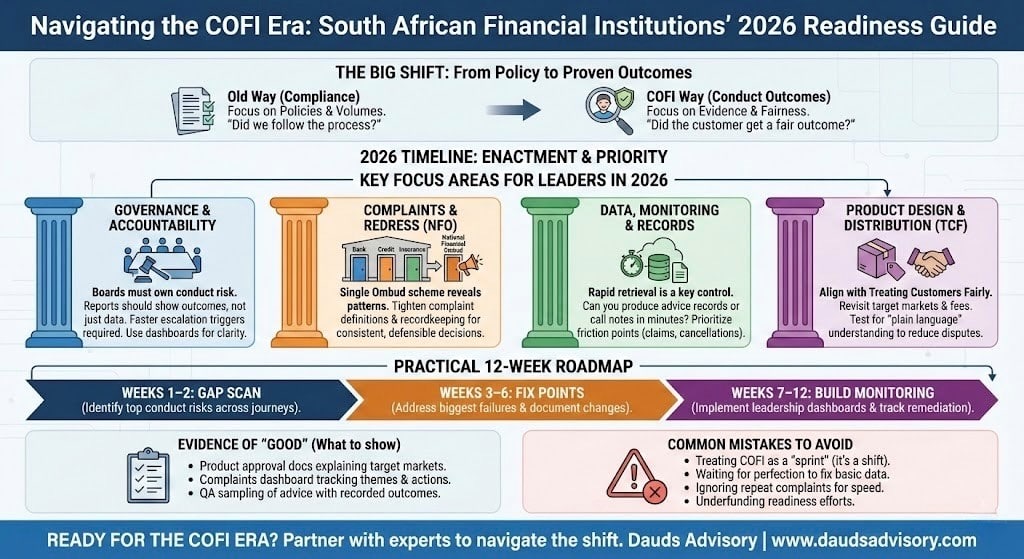
1. Governance and accountability
Boards should expect sharper questions about conduct risk ownership, escalation triggers, and whether reporting shows customer outcomes, not only volumes. A dashboard can be more useful than a long quarterly pack.
2. Product design and distribution
COFI lines up with Treating Customers Fairly, which stresses fairness across the product lifecycle. Institutions should revisit target markets, marketing claims, and fee disclosures, then test whether customers can understand key terms in plain language. Misunderstanding is a common starting point for disputes.
3. Complaints and redress under the new ombud environment
The National Financial Ombud Scheme began operating as a single scheme on March 1, 2024, merging the former banking, credit, and insurance ombuds. With disputes routed through one umbrella, patterns are easier to spot. Many firms will use corporate legal services to tighten complaint definitions, response templates, and recordkeeping so decisions remain consistent and defensible.
4. Data, monitoring, and records
A common readiness gap is retrieval: can the business quickly produce advice records, disclosure acknowledgements, call notes, or claims decisions? If that takes days, the control is weaker than it looks. Prioritize the journeys that generate friction, especially claims and cancellations.
A practical 2026 roadmap you should follow
- Weeks 1–2: Run a gap scan across key customer journeys and list the top conduct risks.
- Weeks 3–6: Fix the biggest failure points and document changes.
- Weeks 7–12: Build monitoring that leadership uses, then track remediation actions with owners and dates.
This is where management consulting solutions can help, especially when product, compliance, operations, and distribution each own part of the customer experience.
What “good” looks like
COFI-aligned evidence often includes:
- Product approval documents that explain target markets and customer communications.
- A complaints dashboard that tracks themes and actions taken.
- Quality assurance sampling of advice or sales interactions, with outcomes.
Common mistakes to avoid
- Treating COFI as a compliance sprint instead of an operating shift.
- Waiting for every detail before fixing data and governance basics.
- Tracking speed while ignoring repeat complaints and poor outcomes.
- Underfunding readiness in business financial planning and reacting late.
Frequently Asked Questions:
When will the COFI Bill take effect in South Africa?
Public reporting suggests COFI is expected to be enacted during 2026, followed by a transition period while conduct standards and effective dates roll out. Timing can still move, so institutions should plan for overlap with existing requirements. Starting with governance, complaints, and records is rarely wasted effort.
Who will COFI apply to?
COFI is intended to apply to financial institutions and regulated activities under the FSCA’s conduct jurisdiction. That includes banks, insurers, investment and retirement product providers, and intermediaries involved in advice or distribution.
What does outcomes-based regulation mean in practice?
It means the regulator looks at results, not just written policies. Institutions will need to show that disclosures are clear, advice is suitable, and servicing is fair. When problems happen, supervisors expect trend analysis, root-cause fixes, and proof that the fix worked.
How does COFI relate to Treating Customers Fairly (TCF)?
TCF sets expectations for fairness across the product lifecycle, from design and marketing through servicing and complaints. COFI builds on that logic and is expected to provide a more unified framework for supervising conduct across the market. Firms with mature TCF programs will still need sharper evidence and board-level reporting.
What should a financial institution do first in 2026 to prepare?
Map core customer journeys and pinpoint where customers most often experience confusion, delays, or repeated errors. Pick a small set of conduct indicators leadership reviews monthly, such as complaint themes and claim outcomes. Then tighten documentation so the business can quickly show what was sold, what was explained, and why decisions were made.