
On 1 March 2026, something shifted quietly in the plumbing of South Africa’s tax system. From that date, crypto-asset service providers, the exchanges and brokers most South Africans use, must record detailed data on every user’s transactions and report it to the South African Revenue Service. The first returns are due in 2027, after which the information flows automatically, with nothing required from the account holder. For the many South Africans who have bought, sold, or earned crypto, one long-deferred question suddenly has teeth: when SARS looks at your profit, does it see a capital gain or revenue income?
The answer is not academic. It is the difference between an effective tax rate of 18 percent and one as high as 45 percent. And in a system with no dedicated crypto rulebook, that answer is rarely yours to decide.
How SARS sees your crypto
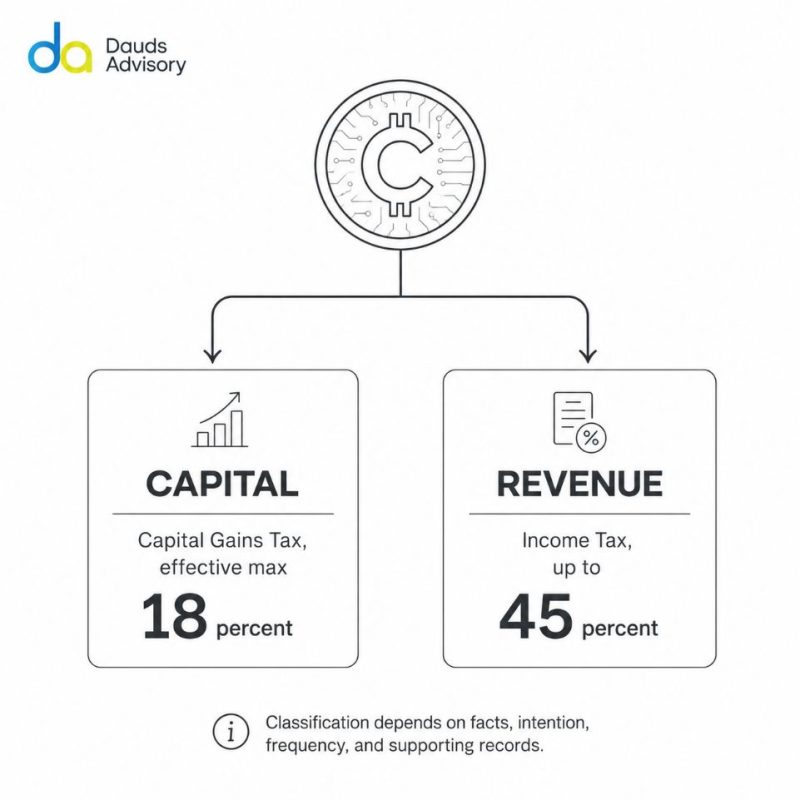
SARS does not treat crypto as money. It sits outside the official definition of currency, classed instead as an asset of an intangible nature and taxed under the existing Income Tax Act. Every time you sell a coin, swap one token for another, spend it, or give it away, you trigger a disposal. Each disposal then lands in one of two buckets. Capital gains are taxed lightly. Revenue income is not. Getting that distinction right early is precisely what sound tax advisory is for.
The line between investor and trader
There is no magic holding period that settles the matter. SARS leans on decades of tax case law and weighs a cluster of factors: your intention when you acquired the asset, how often you trade, how long you hold, and what you do for a living. Coins bought and held for years is read as a long-term investment, and long-term investment is capital. Coins churned week after week to skim short-term profit is read as trading stock, and trading stock is revenue.
A three-year rule does exist in South African tax law, but it applies to shares, not crypto, so it offers no shelter here. Intention is the pivot, and intention is something you must be able to evidence rather than simply assert. This is where considered investment advisory services earn their place, building the paper trail that supports your position long before a return is ever filed.

What each path actually costs
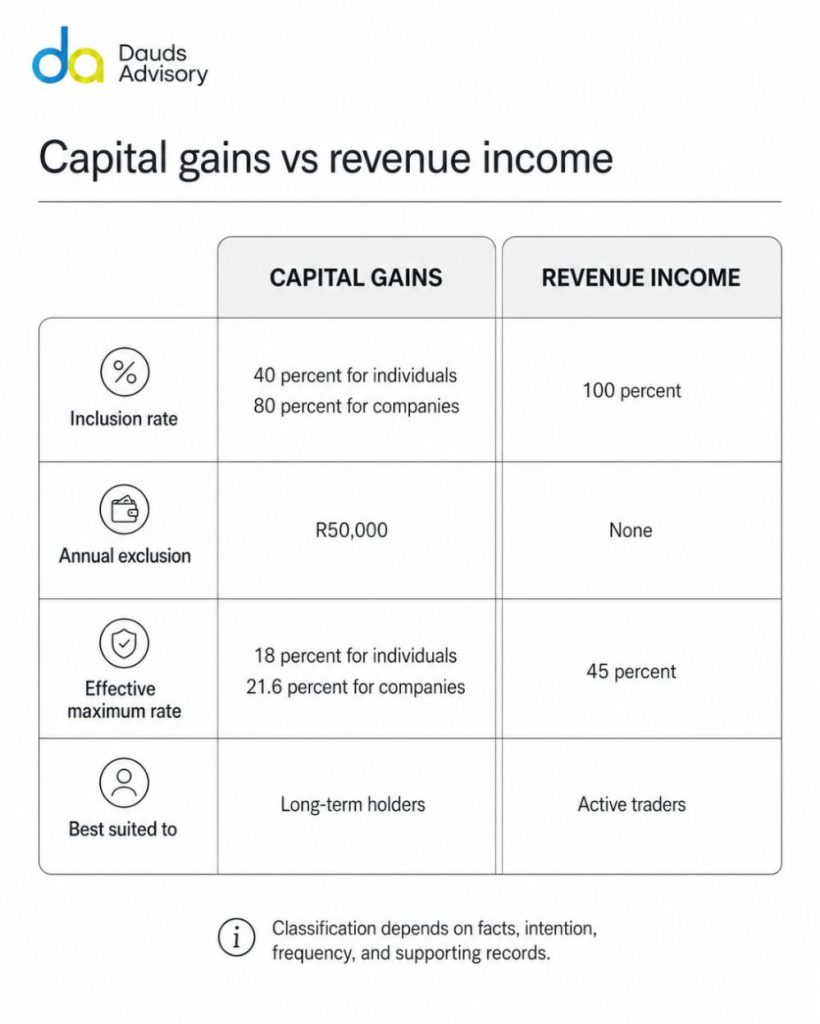
The gap between the two buckets is wide. If your gain is capital, an individual includes only 40 percent of it in taxable income, after an annual exclusion of R50,000 for the 2026/27 year, lifted from R40,000 in the 2026 Budget. The effect is a ceiling of roughly 18 percent. If your gain is revenue, the entire profit is added to your income and taxed at your marginal rate, which climbs to 45 percent, though you may at least deduct related costs and losses.
Companies follow different arithmetic again: an 80 percent inclusion rate at the 27 percent corporate rate, an effective 21.6 percent. For founders and finance teams holding tokens on a balance sheet, that is exactly the sort of structuring question corporate finance advisory exists to answer.
So which is better?
Neither, universally. Capital treatment is gentler on the rate, but it asks you to defend a long-term story under audit, with records to match. Revenue treatment bites harder, yet it lets a genuine trader write off expenses and offset losses against income, which can suit an active operation. A single portfolio can even attract both at once, one coin held for years as an investment, another flipped in a fortnight as stock. SARS assesses asset by asset, not person by person, so a clear financial advisory view of your whole position matters.
The stakes in 2026
That quiet data pipeline switched on in March is the real change. Under the global Crypto-Asset Reporting Framework, South African exchanges now report directly to SARS, with the first batch of data due by 31 May 2027. The comfortable assumption that the taxman would never find out has expired. Non-compliance now risks penalties reaching R1 million or the value of the asset, whichever is larger, and in serious cases, prosecution. For anyone holding meaningful positions, credible blockchain investment advisory has moved from a nice-to-have to plain risk management.
Before you click sell
The classification of a crypto gain is decided on evidence, and that evidence is built long before the disposal. Knowing whether you are an investor or a trader, and being able to prove it, is the single most valuable thing you can do for your tax position.
At Dauds Advisory, our tax, financial, and legal specialists help South African investors and businesses classify, document, and defend their crypto positions before SARS does it for them. Book your consultation to put the right structure in place while it still counts.
Disclaimer: This article is general information and not tax advice. The capital-versus-revenue classification depends on your specific facts and should be confirmed with a registered tax practitioner.